By, Ruel Nolledo | Freelance Writer
February 26, 2026
It’s the first morning of the BlackECE Symposium, and poet Micah Bournes has the stage. The audience — ECE professionals, policymakers, researchers, advocates and more — listen quietly as Bournes speaks with passion and intensity about the lost African languages of his ancestors:
… The closest I got to that was hip-hop.
Is Black talk.
Is improper, non-proper, unproper, uneducated, un-dash-educated, un-stress- assimilated ME talk.
WE talk. OUR talk.
Make-you-all-wish-you-all-knew-what-I-was- talking-about talk.
Make-you-all-ask-your-Black-friend talk.
Make-you-all-run-to-urbandictionary.com talk.
That one thing, that something that belongs to us.
That us you tried to Demonize. Envy. Copy. Despise.
That us you tried to Categorize. Stereotype.
Tried to shame our broken English you can never understand.
But you can never get it because we stay fly. We stay fresh.
We stay changed.
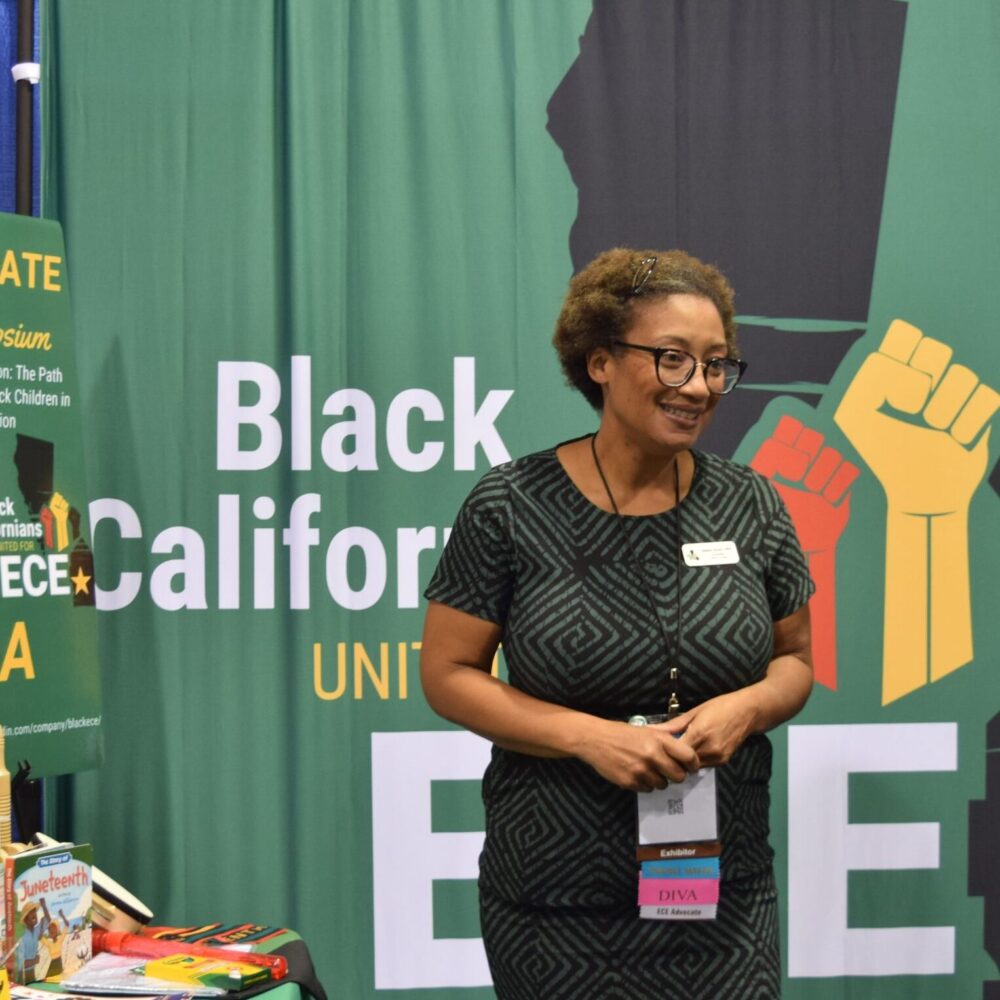
Bournes’ charged words get to the heart of the matter. The two-day event, hosted by Black Californians United for ECE (BlackECE), is intended to serve as a catalyst for advocacy centered around Black English. In fact, many of those in attendance are fluent in Gullah Geechee, Haitian kreyòl, Trinidadian Creole and many other African diasporic language traditions. “Black English is not slang,” explains Samantha Thompson, Black ECE’s Woman Who Makes Things Happen. “It is an essential part of our culture. And it can be used as an asset to improve outcomes for young Black learners.”
***
According to the 2021-22 State of Black Los Angeles County Report, a little over half of Black families reported their children received some form of child care, in contrast to over three-fourths of white families. When Black families do gain access to an ECE system or school, they often encounter environments that fail to reflect or affirm their cultural identities. Meanwhile, the Black women who make up a disproportionate share of the ECE workforce face compounding inequities of their own: Black early educators are paid around $8,000 less per year than their white peers, even when they hold equivalent educational degrees. 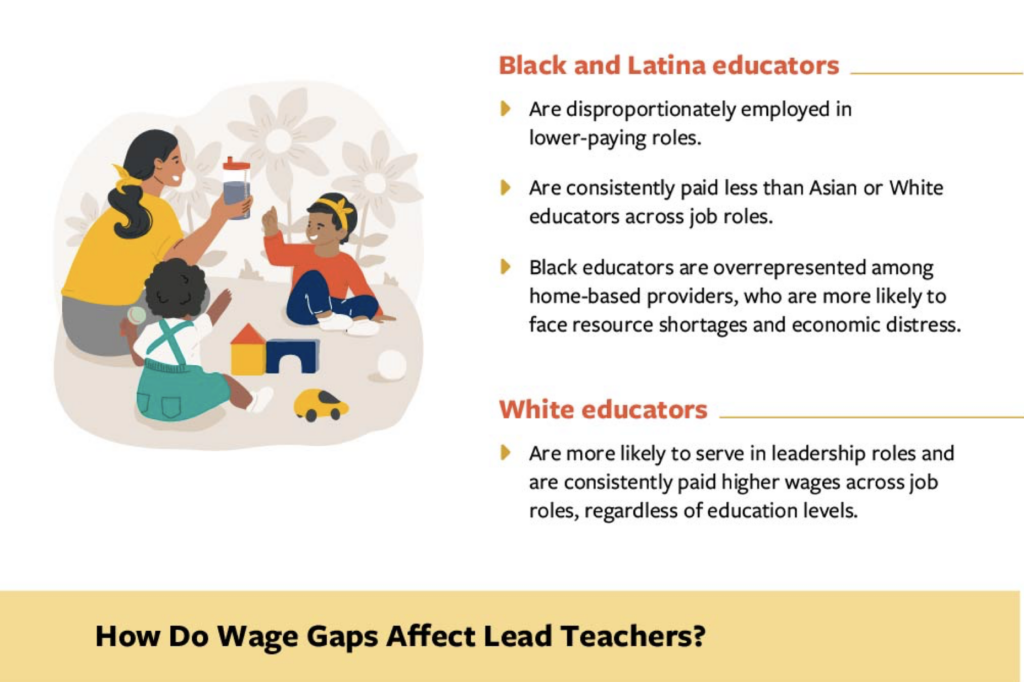
It is against this backdrop — decades filled with systemic underinvestment, racial bias and cultural erasure — that BlackECE is pushing for change. Established in 2022, the organization is committed to ensuring California’s ECE system meets the unique needs of Black children, families and educators, with policies and resource allocations that align with this vision.
To achieve this goal, BlackECE’s work focuses on a simple yet powerful idea: Prioritize cultural affirmation, not just responsiveness, in early care and education. The distinction is subtle but very important, says Keisha Nzewi, BlackECE’s Woman in Charge.
“Culturally affirming spaces go further,” says Nzewi.” They celebrate, empower and lift up Black children’s language, history and joy as assets central to learning.”
Thompson agrees, adding that culturally responsive practices tend to focus on recognition and acknowledgment of a child’s cultural background and family traditions. In contrast, culturally affirming practices take a deeper approach by using those same elements as a means of preserving a child’s culture and even using it as an asset for learning and empowerment.
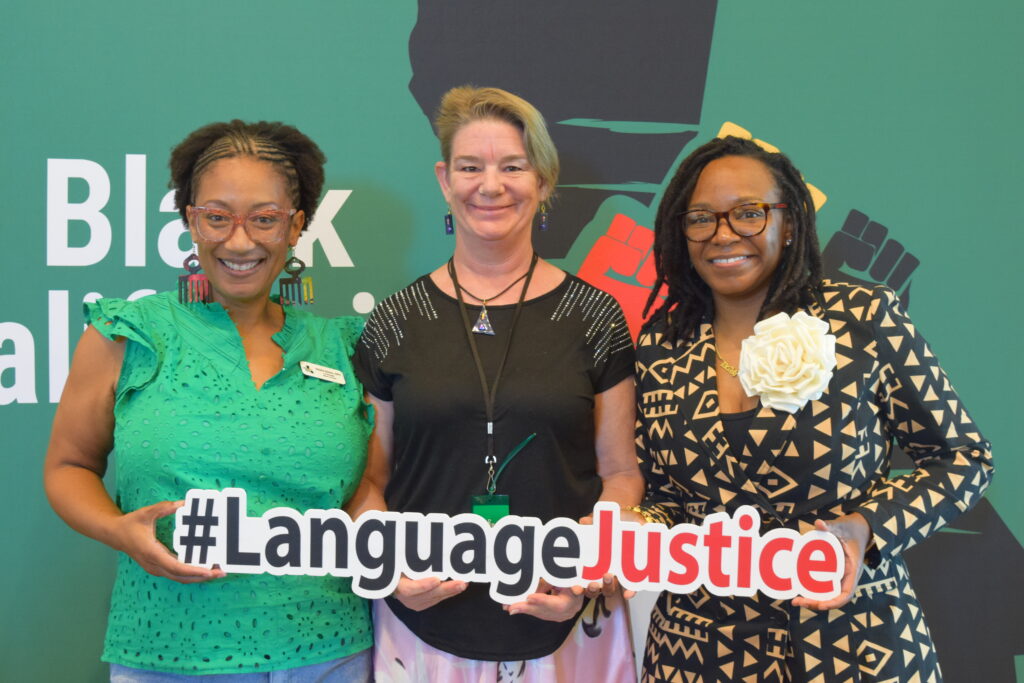
“It’s not just a response or a reaction,” Thompson says. “It’s about fostering a culturally affirming learning experience that’s reciprocal and dynamic. The way you teach can reflect experiences so that the classroom is familiar, welcoming and relevant for a Black child.”
One of the key elements of cultural affirmation lies in understanding the value of home language — the language that a child grows up with and uses to connect with loved ones. Studies have found that when a child’s home language is recognized and valued, it lays a strong foundation for learning, strong self-worth and deep connections to literacy.
That’s why BlackECE is working to reframe the way educators, policymakers and the general public think about Black English. Dismissed for the better part of 400 years as a broken or incorrect speech, Black English has been confirmed by scholars as a rules-based language, one with its own distinctive grammar, syntax and pronunciation and expressive features.
The work is deeply personal for Nzewi. While taking a linguistics class back in college, she had discovered that modern-day Black English wasn’t a corruption of English. Rather, it was a language born of resilience, with words drawn from English but a grammar and syntax woven from the hundreds of languages spoken by ancestors who were stolen from many lands.
“That’s when I realized for the first time that the way many Black people speak wasn’t wrong,” recounts Nzewi. “As Black people, we’d been sold a lie. That completely changed my view of Black English.”
To advance its work in language justice, BlackECE has partnered with Early Edge California, Catalyst California, and Californians Together to form the Black English Language Workgroup, a coalition committed to challenging language bias in early learning settings and shifting policy and practice so that Black children’s home language is treated as an asset, not a deficit.
The workgroup will be releasing a series of knowledge briefs and is currently hosting a companion webinar series designed to equip educators, administrators and advocates with tools to create language-affirming environments for Black children.
At the same time, BlackECE is fighting for greater equity in pay for Black ECE providers. Early childhood educators are among the lowest-paid workers in California, but data show that Black educators in particular face a compounded disadvantage. A 2024 study from the UC Berkeley Center for the Study of Child Care Employment, co-authored by BlackECE co-founder Dr. Lea Austin, found that Black educators are regularly passed over for pay increases even after obtaining higher educational degrees. At the same time, Black educators make up 8% of the early childhood workforce, yet account for 13% of in-home providers — the group most likely to report economic stress.
To address these inequities, BlackECE launched Lift Every Voice (LEV) in 2023. Dedicated to empowering and amplifying the voices of Black ECE providers from across California, LEV gives providers the opportunity to speak directly with elected officials and other policymakers. During its 2025 Advocacy Day in Sacramento, LEV members met with several state senators and assembly members to discuss wage reform, inequitable access to resources and lack of representation.
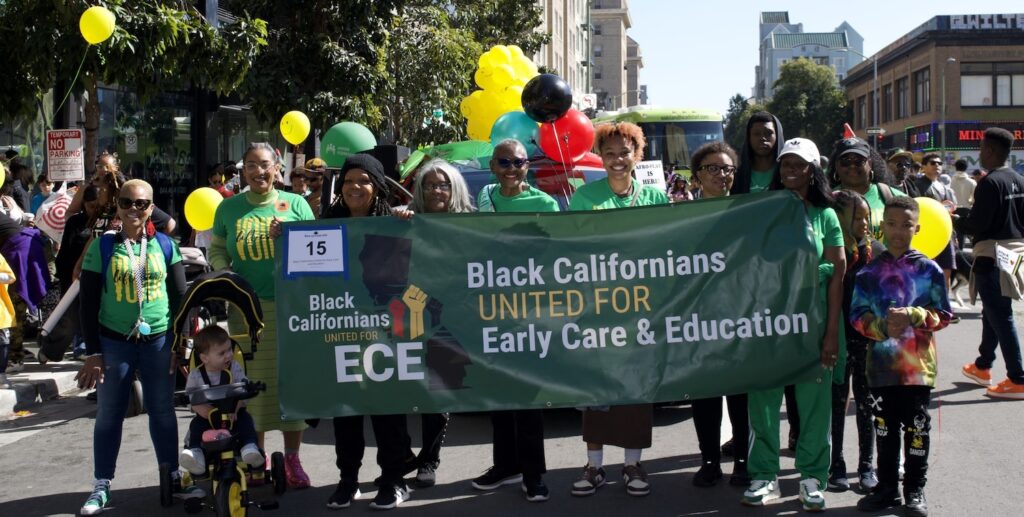
Despite its relatively brief existence, BlackECE has managed to accomplish much. And even though the work is just beginning, it’s already caught the attention of ECE providers and advocates Nzewi has spoken to at national conferences.
“One of the most common refrains we hear is: We need a BlackECE here!” shares Nzewi. “We’re filling a void for Black families, early educators and children. So people want us in New York, in Georgia, in Missouri.” The big, bold goal, she adds, is creating a better early care and education system — one where all Black parents are treated as equal partners, not threats. And where their children aren’t pushed to align with the dominant culture.
“We want Black children, families and ECE providers to get to navigate the ECE system and the world with their full selves,” Nzewi says. “Proud of their Blackness, affirmed in their Blackness.”
###