How can we better support those who are teaching and caring for L.A. County’s youngest children?
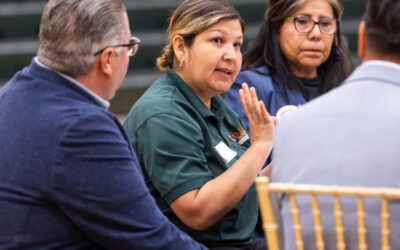
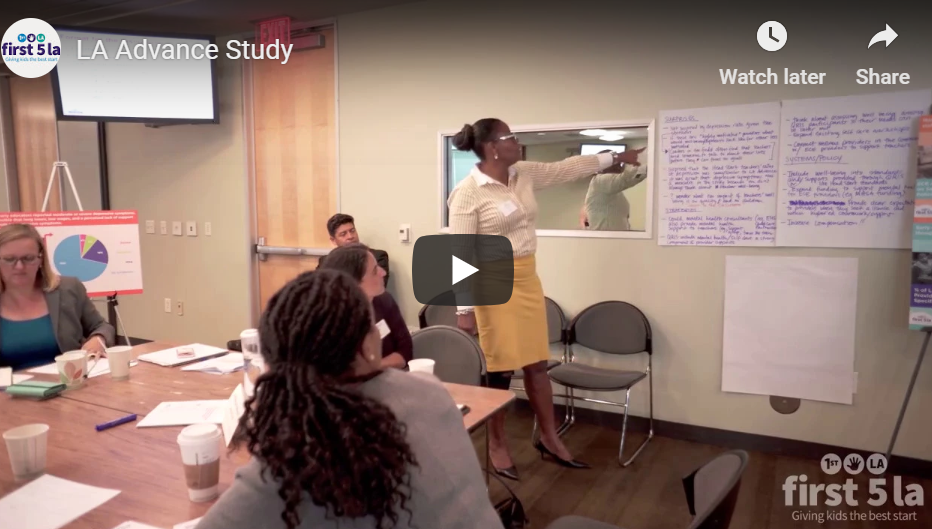
To answer this question, First 5 LA brought together early care and education (ECE) leaders at the LA Advance Learning Session on August 17. The special focus of the day was professional development programs for early educators.
Breakout session reports from LA Advance:
Session participants were asked to provide their feedback on how professional development programs can better serve early educators. This discussion, as shown by the video above and key points below, demonstrates challenges still ahead, but also the continuing commitment of ECE leaders to support this important workforce.
In the meeting, Mathematica Policy Research presented findings from LA Advance, an evaluation of First 5 LA-funded professional development programs. These findings provide an in-depth look at the experiences of over 1,000 early educators who participated in these programs, including their motivations, barriers and what helped them to succeed.
First 5 LA is completing three policy briefs from LA Advance, which will be available here in September.
For more information, please contact Kimberly Hall at 213.482.7516

LA Advance showed how motivated early educators are to improve their knowledge and practice.
Next we need to look at ensuring that their learnings impact classroom quality and they are able to
apply them in real time. PD can be designed to assist early educators in making the changes to make
a difference for kids.
We should review how we will really measure classroom quality. A two-year
study may not be long enough, as teachers need time to absorb the learnings and implement them as they
gain experience. Considerations can include making measurements very goal-specific and ensuring the tools
are appropriate. We also need to discuss differences between program funder goals and teachers’ goals –
they may be fundamentally different.

We saw how professional development programs can encourage and support progress in
higher education. The more we can provide clarity on educational pathways and where they lead, even more early
educators can feel motivated to obtain these degrees and permits.
A counselor in PD programs who
specifically focuses on higher education is a worthwhile consideration.

While early
educators are highly motivated, we need to make sure we address the workplace factors and barriers
that decrease motivation.

Increasing compensation continues to be a clear priority. There are not a
lot of new people entering this field because it is not lucrative. Being closer to where K-12 is, would
be an important goal to consider.

We need to keep in mind our greater policy goals that would impact compensation and
barriers, including advocating for universal early care and education.
.gif)

We know
relationship-based PD works, but we have to remember it’s not just about 1 to 1 learning.
It is an intentional dynamic and shouldn’t be taken lightly – it requires reflection,
checking-in and a meaningful curriculum that serves as the foundation.
People want mentoring
and coaching that can support them in different areas, like employment and teaching methods. We saw
how mentors can offer a broad, long-range view and provide a visual pathway for early educators. This
helps them to think differently about what they can achieve.
We should look at language and culture,
and how that affects relationship-based PD. Building in time for this learning in order to truly understand
each other is important.

We don’t often think about the well-being of teachers. Teachers need
someone to talk to about issues, well before they set goals. Making mental health consultants available in
PD programs, or including self-care workshops could provide some much-needed support.
There’s an
opportunity to partner with existing community resources. As early educators provide services to the
community, local mental health agencies can be there for the teachers – creating a “circle of
support.”