By, Ruel Nolledo | Freelance Writer
May 28, 2026
Prevention and early intervention was the underlying theme of the First 5 LA Board of Commissioners meeting on Thursday, March 12, with a full agenda that touched on data, advocacy and the renewed local efforts to address the new challenges facing L.A. County families. In addition to approving several consent items, Commissioners also heard from staff on how young children and their families would be affected by the current federal and state budgets; the state of well-being and opportunity across LA County; and local prevention efforts underway to protect families amid ongoing federal uncertainty.
Chair’s Report
During her opening remarks, L.A. County Supervisor and Board Chair Holly Mitchell spoke of the tremendous need to come together as a community during these uncertain times. Many of her fellow commissioners, she added, were currently navigating changing federal policies, evolving state guidance and constrained public resources in their respective arenas.
“The details may continue to evolve,” she said. “But what remains constant is our shared responsibility to ensure families with young children are not left behind.” Mitchell also highlighted a motion her office recently advanced, Strengthening Early Childhood Prevention and Family Stability, which would shift the County from reactive foster care intervention to prevention-based support that stabilizes families before separation becomes necessary.
Due to the full agenda, President & CEO Karla Pleitéz Howell submitted a written report in lieu of a verbal update. Her report can be found here.
Federal and State Budget Update
Vice President of Community Engagement & Policy Aurea Montes-Rodriguez was joined by Chris Hoene, executive director of the California Budget & Policy Center, to brief the Board on the current fiscal landscape. Montes-Rodriguez noted that federal policy instability continues to threaten critical supports for children and families, with uncertainty surrounding funding cuts and program eligibility changes being explored by state legislators. She added that First 5 LA’s policy team was closely monitoring the governor’s proposed budget and the potential impacts of the federal decisions on L.A. County’s children, young children and families.
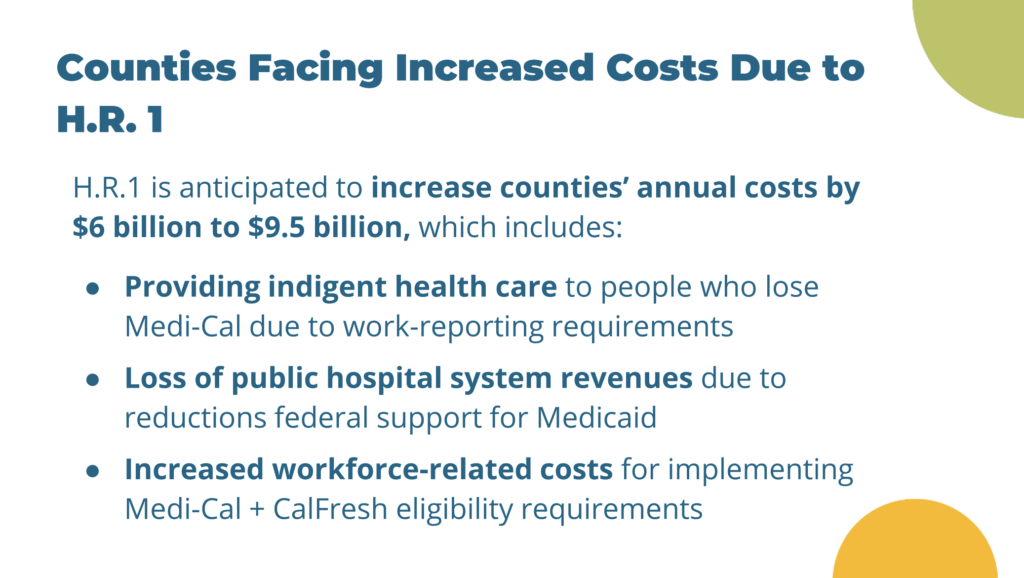
Hoene provided a broader context on how those federal headwinds are shaping California’s budget outlook and the difficult choices ahead for state policymakers. At the local level, H.R. 1 is expected to substantially increase counties’ annual costs.
Hoene added that the budget process was going to move forward very quickly over the next two months. “Make sure your voice is heard,” he emphasized, “particularly between now and May.” During the discussion after Hoene’s presentation, Commissioner Barbara Ferrer emphasized that any federal cuts to vital support programs should not be seen as affecting just low-income families, but as a danger to the broader infrastructure.
“It’s not just that services go away for people who need those services,” Ferrer stated. “These cuts are extremely disruptive to the economy, which means they will be disruptive to everyone across the board. Every time we lose a federal grant, it not only affects the services that we’re providing… but it also means that people lose their jobs and can’t contribute in the same way to the economy because they now have no wages.”
“These are not small, insignificant cuts that can be absorbed in any one sector at all,” she added. “So, I think we need to highlight that part of the story.”
More information can be found in the presentation here.
Measuring Well-Being and Opportunity in L.A.
Building on a partnership that began nearly a decade ago, First 5 LA staff presented A Portrait of Los Angeles County 2026, a detailed analysis of well-being and access to opportunity produced in collaboration with Measure of America. Montes-Rodriguez opened the presentation by describing the community engagement efforts that informed the report, with more than 235 community members participating in Data Walks across five Best Start communities.
“In keeping with our commitment to elevating families’ lived experiences and policy discussions,” she explained, “our Data Walk centered the voices of parents, caregivers and community members. Their insights directly informed and are reflected in this important countywide report on well-being, equity, and opportunity.”
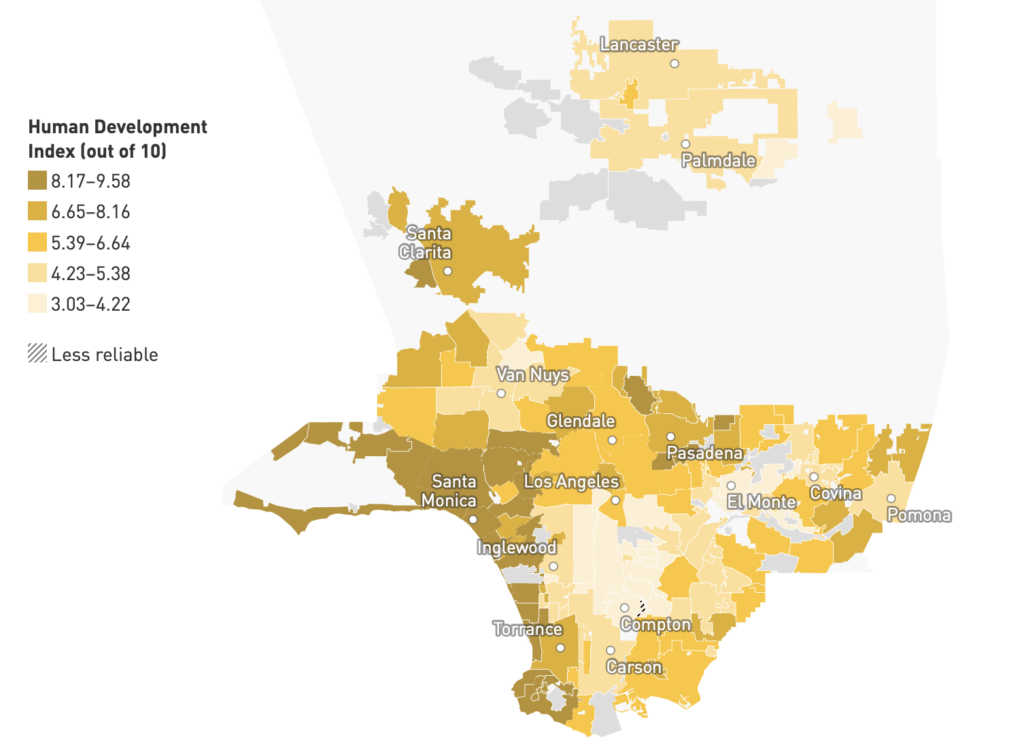
Measure of America Director Kristen Lewis spoke next to guide Commissioners through the report’s core findings, which were organized around a Human Development Index (HDI). The HDI, Lewis explained, assesses three dimensions of a good life: a long and healthy life (measured by life expectancy at birth), access to knowledge (measured by school enrollment and educational attainment), and a decent standard of living (measured by median personal earnings).
Although LA County’s overall HDI score of 5.64 out of 10 represents a small improvement over its 2017 score of 5.43, it falls short of the one-point improvement goal set in the last report. Lewis noted that the report found substantial HDI disparities across race and ethnicity, birthplace, geography, unequal access to services and gaps in housing stability and economic opportunity.
“There’s nothing natural or inevitable about the kind of inequality that we see in L.A. County,” Lewis explained. “The landscape of inequality we see today is the result of deliberate policy choices and investments that favored some and excluded others over decades. But different policy choices can create a different, better, fairer future, one in which all Angelenos not only survive, but thrive.”
Lewis highlighted nine recommendations in the report, spanning health, education and standard of living. The full report is available at measureofamerica.org, along with a downloadable dataset and an interactive map that allows users to explore HDI scores by neighborhood.
Holding the Line for Families
Commissioners next heard from a panel of county and city partners on ongoing efforts at the local level in response to a rapidly shifting federal landscape. Montes-Rodriguez began the presentation by explaining to commissioners that the overall goal was to provide a clearer overview of prevention efforts in the county. “We want to take a step back and look at prevention, not as a single program, but as infrastructure,” she noted. “Infrastructure that helps families stay stable before challenges become crises, that allows systems to respond quickly and effectively when conditions shift.”
Montes-Rodriguez added that these efforts, similar to First 5 LA’s Prevention First initiative, sought to keep families together, with a focus on housing and poverty alleviation.
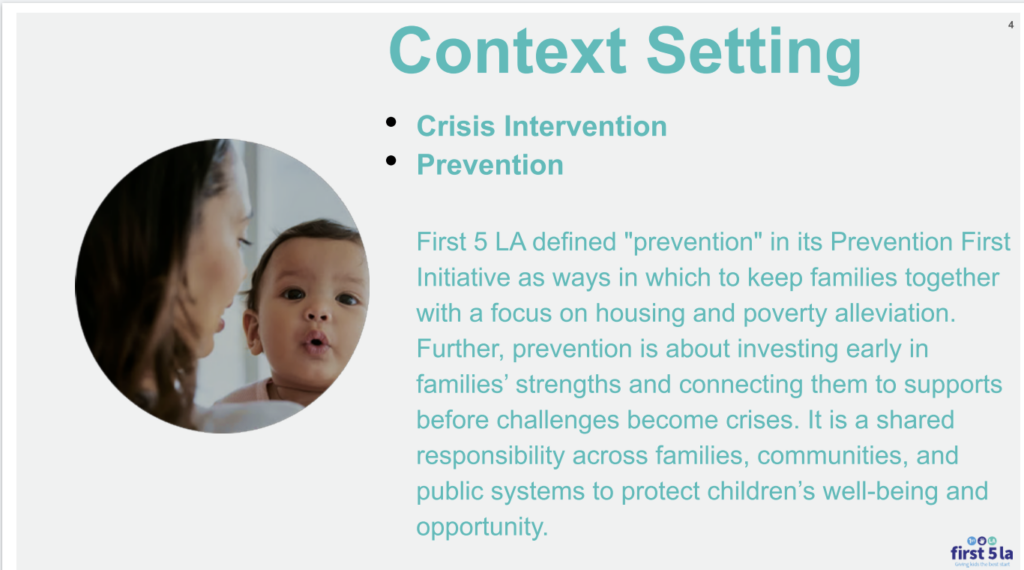
“For us, prevention means investing early in family strengths, so thinking about strengths and connecting them to supports before challenges become crises, ” she said. “It’s a shared responsibility across families, communities, and public systems to protect children’s well-being and opportunity.”
Guest presenters included:
Dr. Carrie Miller, senior manager at the L.A. County Policy Implementation and Alignment Branch, provided an overview of the crisis contingency plan undertaken in response to the federal funding freeze of several major funding streams that underpin much of LA’s social safety net: the Community Development Block Grant, CalWORKs, and Child Care and Development Funds.
Kristina Meza, executive director of the Poverty Alleviation Initiative at the same branch, shared updates on the county’s newly launched dashboard and on the county’s ongoing guaranteed income efforts.
Debra Colman, director of the L.A. County Office of Advancement for Early Childhood Education, presented on L.A. County’s Infant/Toddler Early Care and Education System Blueprint, which features a range of strategies to expand capacity, improve affordability, and strengthen the ECE workforce.
Veronica McDonnell, Assistant General Manager of the City of LA’s Community Investment for Families Department, spoke to the work of the city’s FamilySource centers, place-based community hubs delivering wraparound services to families across Los Angeles.
Montes-Rodriguez closed the presentation with an update on First 5 LA’s development of a hubs framework model to support the community’s work.
All of the speakers’ presentations can be found here.
Additional Matters
As part of the consent agenda, the Board approved the FY 2025-26 Mid-Year Revised Budget (more information here) and authorized First 5 LA to receive up to $100,000 from WestEd to support the Building Equitable Early Learning and Care Systems (BEELS) Project through September 27, 2027 (memo can be found here).